Google August 2026 Spam Update

the rollout is over and everybody has brought a favorite suspect to the lineup
AI pages link farms expired domains parasite sections
Google named none of them
the reporting desk is turning the rumor board face down and checking what the machine was built to catch what moved and what never graduated from a guess
THE SIGNAL
Google's August 2026 spam update affected concentrated groups of high-ranking URLs inside otherwise normal sites and portfolios. It did not hit whole industries evenly.
In the largest study, URLs ranking in Google's top 10 results were about 1.8 times more likely than normal to fall beyond position 100. In the smaller studies and public cases, most of the damage sat inside one project, one hostname, or one group of pages while neighboring properties stayed stable.
An events project lost one-third of its top-ten rankings. An Italian root hostname reportedly lost almost all its impressions while five parallel language subdomains held. Fashion and beauty had the highest volatility in the large U.S. keyword sample. Healthcare and real estate were among the steadiest.
Google pushed particular ranking cohorts out of sight. The evidence does not support calling this an industry purge, an AI-content purge, or a penalty applied evenly across every domain.
SEO consultant Glenn Gabe reviewed four blinded sites that he identified as confirmed August spam-update hits. Every affected site depended heavily on pages produced at scale.
Gabe's cases indicate that the spam update affected sites when a large share of their search visibility came from scaled pages with little original value, especially when those pages also relied on AI filler, thin affiliation, scraping, or misleading functionality.
WHAT GOOGLE SAYS IT WAS FOR
Google's spam systems run continuously. When the company makes a notable improvement, it announces a spam update. Google's public guidance names SpamBrain as an AI-based spam-prevention system and says improvements can help it catch new kinds of spam.
The August update ran globally across all languages from August 18 through August 21. Google called it a normal spam update. It announced no new policy, which means the update was enforcing rules that already existed.
Those rules cover scaled content abuse, scraping, expired-domain abuse, doorway pages, site-reputation abuse, hacked content, cloaking, misleading functionality, and link spam. Google has not said which detector changed or which part of that list mattered most.
AI use by itself is not the violation. Google's policy covers content produced at scale to manipulate Search or generative AI answers, regardless of whether a person, software, or both made it. Treating every affected site as an "AI content" casualty skips the part that needs proof.
HOW HARD IT HIT
Danny Goodwin reported for Search Engine Land on an SE Ranking study of the same 100,000 U.S. organic keywords across 20 industries. The study compared rankings immediately before and after the update with a five-day July period that had no confirmed update.
Of the URLs that had ranked in the top ten, 16.71% fell beyond position 100. During the July baseline, 9.2% did the same. A URL in Google's top 10 results was about 1.8 times more likely to vanish from the tracked results during the spam update.
SE Ranking also found a 12% increase in URLs reaching the top three after previously sitting below the top 20. Some pages disappeared from view while replacements jumped several result pages.
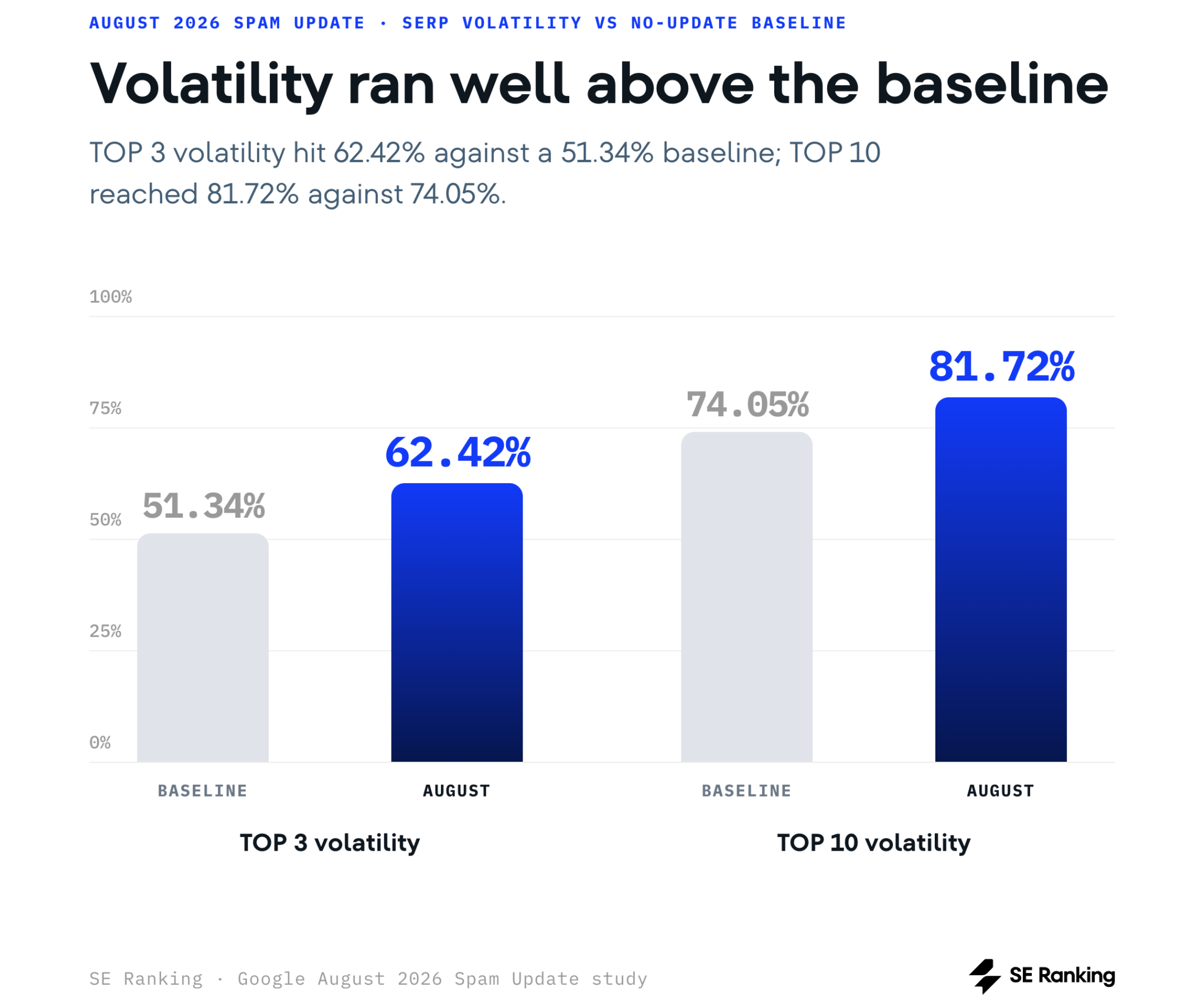
SE Ranking measured higher top-three and top-ten volatility during the update window. Chart published by Search Engine Land from the SE Ranking study.
The volatility touched all 20 industries in the sample. Top-ten volatility ranged from 74.64% in real estate to 85.55% in fashion and beauty. Healthcare and real estate, both YMYL categories, were among the steadier groups. Google did not apply the same pressure to every niche.
The study cannot tell whether the missing URLs were deindexed or had fallen below position 100. It also did not compare the pages that lost with the pages that replaced them, so it cannot identify the trait that caused the loss.
WHO APPEARS TO HAVE BEEN HIT
Gabe's programmatic YMYL case lost rankings for more than 200,000 queries. The thin affiliate site lost more than 14,000. The misleading site lost or dropped for close to 25,000 queries. In the 1.5-million-URL case, the impact spread beyond the programmatic section and reached the domain more broadly.
All four sites could create enormous numbers of pages with little human involvement or original information. AI use alone was not the common factor. Gabe recommends starting with Google's content-related spam policies, particularly scaled content abuse, thin affiliation, doorway abuse, and scraping.
Glenn Gabe's four blinded cases tied heavy query losses to scaled page systems. The totals are reported estimates, not a representative market sample.
Álvaro Peña de Luna measured eight projects across eight sectors using 1,357 tracked keywords in Spain. Seven projects had a normal week. Across the portfolio, ordinary ranking movement and disappearances from the tracked range barely changed. Top-ten losses did change, rising from 5.6% in the control week to 10.8% during the update.
Almost all of that difference came from one events project. Its top-ten loss rate jumped from 9.3% to 33.7%. Remove that project and the portfolio-wide difference falls inside the noise. Legal, automotive, logistics, and pharmacy did not share the same hit.
The events project carried almost all the measurable damage in iSocialWeb's eight-project comparison.
Public tracker averages stayed calm in Harsh Songra's AirPulse field note. Airmeet barely moved, while AirPulse gained impressions but weakened in average position.
In Google Search Central Community, the owner of milazzo.life reported a 98% to 99% loss of impressions on the Italian root hostname, while five localized subdomains with similar templates and inventory remained broadly stable. Another owner said the exact-domain query for plix.gg stopped returning the homepage, even though the site remained indexed and Search Console showed no manual action or security issue.
Both reports describe ranking suppression rather than confirmed deindexing. They are self-reported cases without complete before-and-after exports, so neither proves the update caused the loss.
Affected sites do not share a confirmed CMS, language, content-production method, or link tactic. Top-ranking pages inside one project, host, section, or query group fell hard while the rest of the portfolio stayed ordinary.
Fashion and beauty recorded the highest top-ten volatility in the 100,000-keyword study, and one events project was the obvious loser in the Spanish portfolio. Those are the only named category signals supported by measured samples. They are not enough to claim Google targeted either category.
WHAT TO CHECK ON YOUR SITE
Determine whether you have a site-wide loss or a wounded section. Compare pages and queries, then split them by directory, template, country, device, and hostname. Investigate any subdomain, locale, content class, or page template carrying most of the loss.
Check whether the affected URLs are still indexed. Search Console's URL Inspection report can separate pages that vanished from the index from pages that remain indexed but no longer rank. Also check Manual Actions, Security Issues, canonicals, robots directives, redirects, and server responses before blaming the update.
Then compare the losing group with pages that held or gained. Look for copied or lightly transformed source material, doorway patterns, expired-domain history, third-party sections, large batches of similar pages, hidden redirects, hacked content, misleading functionality, or links created to manipulate ranking. A site-wide content purge will hide the pattern you need to find and can destroy pages Google never had a problem with.
If the site is stable, do nothing. If one coherent group lost visibility, audit that group against the spam policies and preserve your exports. Google warns that automated reassessment after a spam update can take months. A frantic rewrite this week will not produce a clean answer next week.
CONVERSATIONS WORTH READING
- Glenn Gabe's four August spam-update case studies provide the strongest practitioner diagnosis of who was hit. The sites are blinded, but Gabe documents their scale, page systems, policy exposure, and query losses.
- The SE Ranking analysis reported by Danny Goodwin measures disruption across 100,000 keywords and 20 industries. It cannot identify the affected page types or spam tactics.
- Álvaro Peña de Luna's eight-project analysis is the most useful counterweight to the big headline. Seven projects looked normal and one events project carried almost the entire measurable effect, which is exactly why site owners should inspect cohorts instead of treating the whole domain as contaminated.