Transmission / 19 Aug 2026
Google says the August spam update did not start early
Google drew a hard line around the August spam update's start time. Here's how to separate rollout movement from the noise already on your charts.
nice try
Google says the August spam update did not start early
the switch flipped when the bulletin hit
so every chart already bleeding on Monday belongs to another crime scene
the timeline is clean now
the explanation still isn't
THE SIGNAL
Google has ruled out one tempting explanation for the volatility that appeared before the announcement. Within the first 24 hours, Google's John Mueller said the company does not roll announced updates out before announcing them. Google tries to publish the notice as close as possible to the actual deployment.
In a second reply on the official Search Central thread, Mueller explained why named updates still exist when many Search systems update continuously. Google announces the bigger or broader changes so site owners have some context when their metrics move sharply.
At the August 19 evidence cutoff, the August 2026 spam update was still rolling out globally across all languages. Google had not named a spam technique, an affected group of sites, or the percentage of searches involved.
WHAT CHANGED
Then: We knew the update started on August 18, but the ranking volatility already visible before the announcement was still being folded into the story.
Now: Google has drawn the start line. Movement that began before August 18 at roughly 12:28 p.m. EDT is not evidence of this rollout. This was a larger change to spam systems that already update continuously, not the moment Google switched spam detection on.
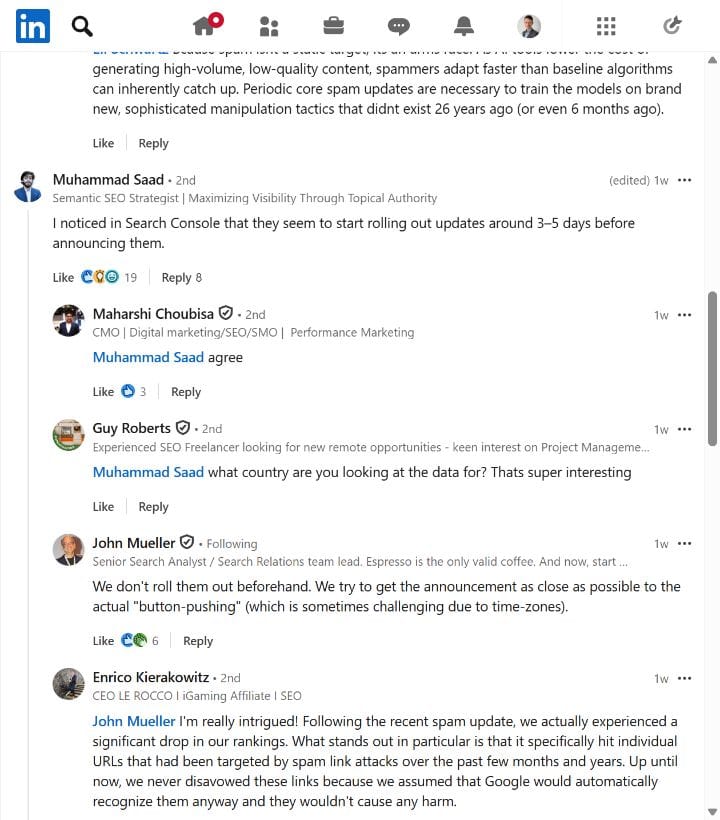
On the official Search Central LinkedIn thread, Muhammad Saad raised the early-rollout theory. John Mueller rejected it. Screenshot captured from LinkedIn.
THE IPR READ
IPR analysis: the suspect list got shorter. It did not get smarter.
The timing clarification removes several days of pre-launch volatility from this investigation. That cuts down false attribution. It does not tell us what changed inside the spam systems or which sites may be affected.
Every confident theory about the update's target runs into the same problem. Google's public announcement calls this a normal spam update and names no specific policy area. First-day screenshots and comments can give us leads. Without a defined before-and-after group, they cannot separate this rollout from ordinary ranking movement, technical trouble, seasonality, or the volatility that was already underway.
The read changes if Google names a target or reproducible cases show the same post-launch pattern across comparable pages and queries. For now, the start time is clear. The affected profile is not.
SIGNAL VS. STATIC
| Signal | Static |
|---|---|
| The rollout began August 18 at about 12:28 p.m. EDT. | Google began this announced update several days early. |
| The update is global and covers all languages. | One traffic dip proves a site was hit. |
| Google announces larger changes to systems that also update continuously. | The update specifically targets AI content, affiliates, expired domains, or links. |
OPERATOR ORDERS
Mark August 18 at 12:28 p.m. EDT in your reporting. In Search Console, export page and query performance for August 4 through August 17 as the pre-update baseline. Keep country and device in the export. Save the same view for August 18 onward when the delayed data arrives.
Start an investigation only if the same group of pages or queries loses clicks, impressions, and position after the launch boundary, and the loss holds beyond the rollout. A decline that began earlier belongs to a different investigation.
Do not rewrite pages, change canonicals, prune content, or disavow links because of one day of movement. Google's standing spam-update guidance tells affected sites to review the spam policies. It does not justify choosing a violation first and auditing backward from the panic.
Seeing a post-launch pattern? Send the affected URL or page type, query, country, device, the time movement began, and a Search Console export that preserves the before-and-after dates.

|